Multimeters
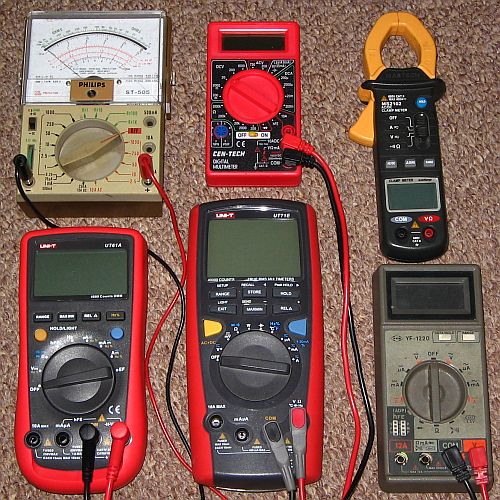 Every
electronician uses multimeters. And some electronicians develop a
fetish for multimeters, collecting many of them. For most of my
life I have only bought the multimeters I really needed, which were
very few, but lately I have been adding some more, so I decided to
write this page in order to let other people see why I bought which
meter, what's good and what's bad about them, and specially help others
to decide what features to look for when shopping for multimeters.
Every
electronician uses multimeters. And some electronicians develop a
fetish for multimeters, collecting many of them. For most of my
life I have only bought the multimeters I really needed, which were
very few, but lately I have been adding some more, so I decided to
write this page in order to let other people see why I bought which
meter, what's good and what's bad about them, and specially help others
to decide what features to look for when shopping for multimeters.
Multimeters come in two big classes: Analog and digital. Each of these
have their own set of strengths and weaknesses, so it's a very good
idea to own at least one of each type. Analog meters excel in measuring
variable, unstable signals. The meter will simply show the average of
fast varying signals, or follow slowly varying ones, while digital
meters will give almost unreadable, unstable sequences of numbers. On
the other hand, digital meters are enormously more accurate and
resolving, and also can take more abuse, like being dropped on the
floor, or putting 500 volts into them while set to measure
resistance. It does happen...
But then, many digital meters are great liars: Under some specific
conditions, they might give totally wrong output, due to saturation
effects, RF pickup, or whatever. Analog meters instead are dumb and
honest. Not very accurate, but they won't lie.
Most analog meters are very simple affairs: Just a highly sensitive
galvanometer, along with a set of dividing resistors and a switch to
select them, to make the different range. Their batteries are used just
to provide a power source for measuring resistance, continuity, diodes,
etc, but isn't needed for measuring voltage and current. Most of the
time, these meters draw no power, and can be left on indefinitely.
Some analog meters include a high input impedance amplifier. In ancient
times these were called "vacuum tube voltmeters", while more modern
ones used FETs. Some advanced analog meters have autoranging functionality.
Digital meters come in two main flavors: Manual ranging and
autoranging. Some electronicians have a strong preference for one or
the other type. The fact is that each type has specific advantage:
Convenience for the autoranging ones, speed for the manual ones,
because they don't have to determine the proper range for every
measurement. My opinion on this matter: Since almost all autoranging
meters can be switched into manual ranging mode, I prefer autoranging
meters, which give me both systems in a single meter. So I can use what
best suits each measurement I do.
Simple digital multimeters often have the same basic structure as an
analog meter: A bunch of ranging resistors and a range/function
selector, combined with a basic instrument. Only that this basic
instrument, instead of being a galvanometer, is a single-chip digital
meter. Old meters very often used the ICL-7106 chip. Autoranging meters
often have a purpose-designed chip, that has all functions built in. A
later trend is to build multimeters around standard microcontrollers,
like a PIC or Atmel. These can have many clever additional functions,
but often suffer from excessively high current drain, and designers
tend to build tricky software into them that can sometimes fool the
user.
Now let's round up all multimeters I have owned in my life! I will describe them in the order I got them.
Kaise 242
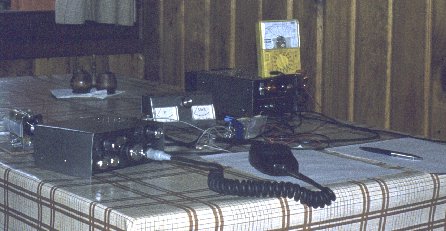 I
got this meter by special request from Santa Claus, at a rather tender
age (at least for an electronician), when Santa was still a good excuse
to get much-needed things otherwise unobtainable. It served me very
well for several years. Since film for my camera also had to be
obtained from Santa Claus, and was scarce, I never shot a photo of the
meter by itself, and you have to satisfy your curiosity with this
photo, that shows the meter along with a completed lab power supply, 40
meter DSB QRP transceiver, SWR meter, plus a bare bones 30 watt linear
amplifier and antenna tuner, all of them build with no other measuring
instrument than this multimeter.
I
got this meter by special request from Santa Claus, at a rather tender
age (at least for an electronician), when Santa was still a good excuse
to get much-needed things otherwise unobtainable. It served me very
well for several years. Since film for my camera also had to be
obtained from Santa Claus, and was scarce, I never shot a photo of the
meter by itself, and you have to satisfy your curiosity with this
photo, that shows the meter along with a completed lab power supply, 40
meter DSB QRP transceiver, SWR meter, plus a bare bones 30 watt linear
amplifier and antenna tuner, all of them build with no other measuring
instrument than this multimeter.
This was a plain, simple, inexpensive multimeter of its time, the late
1970's. I think it was made in Taiwan, and the brand and model number
are purely from memory, so I hope I got that right! The meter measured
AC and DC voltage, resistance, and current up to 250mA, if my memory
doesn't kid me. In addition to the main two probe terminals, it had a
capacitor-coupled terminal, used to measure the AC component while
stripping the DC.
This meter was a 20 kΩ/V instrument. Modern electronicians might need
an explanation about this. Basically, when measuring DC voltage, such a
meter was simply a sensitive galvanometer in series with a total
resistance selected accoring to the range. For example, the
galvanometer might give full scale deflection with 50µA flowing through
its coil. So, for any desired voltage range, enough resistance was
connected in series to make 50µA flow when the full-range voltage was
applied. The total input resistance would then be 200kΩ in the 10V
range, 20MΩ in the 1000V range, and so on. Hence that kΩ/V rating.
20kΩ/V was average. Good meters had more, up to 100kΩ/V for the best,
while the cheapest meters could have just 5kΩ/V or even less.
This multimeter had a single AA battery inside, for the resistance ranges.
It served for several years, but then the meter movement started
becoming sticky, due to wear. Several times I opened it up and tried to
clean the movement, adjust its clearance, but things kept getting
worse, until the Kaise had to be pensioned. Anyway over that time I had
blown up resistors in it on several occasions, by forgetting to set it
to the proper range before measuring some voltage. These analog meters
weren't forgiving of such mistakes. Since 1% accurate resistors were
unobtainable where I lived, I replace the burned resistors by selected
5% ones, using combinations in series or parallel to keep a decent
accuracy. When the meter movement finally got too worn for continued
use, I declared the meter dead, and obtained a new one. Eventually I threw away the carcass of the Kaise. I still keep all my other multimeters, in good operating condition.
Philips ST-505
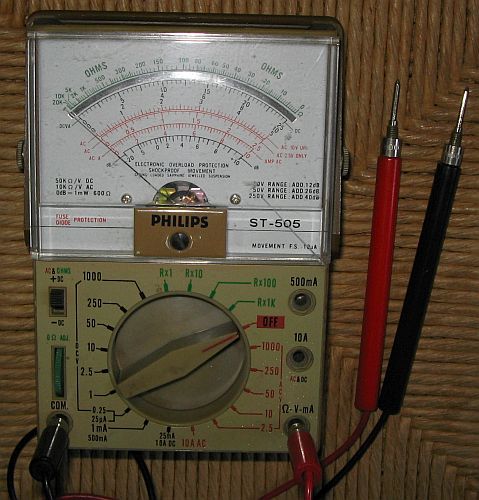 This
is a better quality analog meter. It has a 50kΩ/V rating, thanks to a
very sensitive meter movement with sapphire bearings, and it also has
some degree of built-in protection. It has a 10A current range too,
which I missed on the old meter. It uses two AA cells to power the
resistance measurement, and the full 3V are available at the test
probes, so that the meter can even test white LEDs - which didn't exist
at all when the meter was made. On the other hand, this high testing
voltage makes semiconductors in circuits conduct, so that it's often
not possible to measure the resistance values of resistors connected to
a circuit containing semiconductors.
This
is a better quality analog meter. It has a 50kΩ/V rating, thanks to a
very sensitive meter movement with sapphire bearings, and it also has
some degree of built-in protection. It has a 10A current range too,
which I missed on the old meter. It uses two AA cells to power the
resistance measurement, and the full 3V are available at the test
probes, so that the meter can even test white LEDs - which didn't exist
at all when the meter was made. On the other hand, this high testing
voltage makes semiconductors in circuits conduct, so that it's often
not possible to measure the resistance values of resistors connected to
a circuit containing semiconductors.
One quirk of this meter, and of many analog multimeters, is that during
resistance testing the polarity of the test leads is reversed. The
positive lead becomes negative! This must be remembered when using such
meters to test diodes, transistors, etc.
It doesn't have any continuity beeper. Few of these meters did.
Since analog meters are unipolar, so that negative input voltages or
currents make the meter back up to its left side end stop, a polarity
switch is provided on this meter. Of course, reversing the test probes
does the same trick, so this switch is never used in practice.
Note the green ohm adjustment wheel. Like most analog meters, this one
uses the battery voltage, without any regulation, to measure
resistance. This requires joining the test probes and adjusting this
wheel for precise full-scale deflection, before making any resistance
measurement. When changing resistance ranges, this wheel has to be
readjusted, specially between the lowest range and the others, to
compensate for the batteries' internal resistance.
Modern safety-minded people might be horrorized by seeing that this
multimeter doesn't have full insulation around the test lead
connectors. The leads end in simple banana plugs, with lots of exposed
metal. So, if you connect the leads to a circuit carrying high voltage,
and then touch those metal parts of the test lead connectors, you will
get shocked. This was plain normal in that time - electronicians were
assumed to be bright enough to stay clear of energized connections! Not
so today. Today's meters need to be idiot-proof, or they won't get
safety approvals.
All these quirks were totally usual for such meters, and old-time
electronicians know them well, but newer generations might not!
This meter has a mirror arc embedded in the scale. One could adjust the
viewing angle such that the needle was in-line with its mirror
image, to eliminate the reading error that would otherwise result.
When using analog meters, the user needs to understand which scale
applies to which range. For example, AC scales are compensated for the
non-linearity of the diode used to detect the AC, resistance scales are
backwards (zero at the right side), and there is also a dB scale, that
allows measuring audio signals directly in dB above or below 1mW on a
600Ω line.
This meter is still in good operating condition, after over 30 years. A
few times I blew some resistors, but replaced them. It also fell to the
ground a few times, and survived. It went through several big
earthquakes, one of those threw it across the room and buried it under
lots of other stuff. This cracked the window, but didn't affect its
operation.
You may ask why there is an "off" position, when such a meter anyway
doesn't draw any battery power? Well, in that position the function
switch shorts out the meter movement. This dampens any oscillations of
the needle, making the meter movement more resistant to shock during
transport.
Yu Fong YF-1220
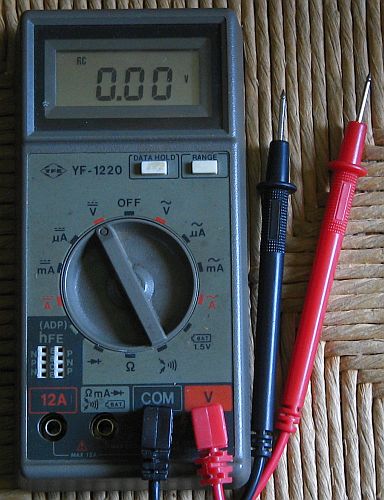 When
I was an university student, in the mid 1980's, I started wanting, or
perhaps even needing, greater precision than an analog multimeter can
provide. At that time I had a modest income from repairing equipment,
so I had gained independence from Santa Claus. But my income wasn't
large, so I wanted an inexpensive meter. A Fluke or any other famous
brand was out of the question, because of the enormous price tag of
their products. I wanted the meter to have lots of functions, too.
After searching the local stores for some time, I decided to buy this
Taiwanese meter made by Yu Fong Electronics.
When
I was an university student, in the mid 1980's, I started wanting, or
perhaps even needing, greater precision than an analog multimeter can
provide. At that time I had a modest income from repairing equipment,
so I had gained independence from Santa Claus. But my income wasn't
large, so I wanted an inexpensive meter. A Fluke or any other famous
brand was out of the question, because of the enormous price tag of
their products. I wanted the meter to have lots of functions, too.
After searching the local stores for some time, I decided to buy this
Taiwanese meter made by Yu Fong Electronics.
This is an autoranging meter having separate resistance, diode and
continuity functions, and the special functions included are a battery
test with load resistor, and transistor gain measurement. Like most
autoranging meters, range selection can be manually overridden. The
display range goes from -1999 to +1999, which was pretty much the
standard in that time. The rated accuracy is from 0.3% for the best
ranges, to a worst case 1.5% for the 10A AC current. That was better
than most cheap meters of its day, and better than many modern ones too.
This meter has some excellent features, and also some nasty ones. Its
best feature, which I really love, is its low power consumption. It
runs on two AA cells, which last almost forever! The current drain is
slightly under 0.4mA, which should give roughly 5000 hours of operation
before the batteries need to be changed. The meter doesn't have an
automatic shut-off function, and doesn't need one. I have often
forgotten to switch it off, sometimes for weeks, and it just keeps
working fine. I replace the batteries once every 5 years or so, just as
a prevention against possible leakage, not because they are drained!
Among the other good features is that this meter rarely does any real
nonsense. It simply works as expected, and its readings are reliable.
Now the bad features: This meter is odd in that one terminal is only
for voltage measurement, while another terminal is used for all other
functions except the high current range. In typical electronic work one
is constantly switching between voltage and resistance or continuity
measurements, and with this meter that means that one is also
constantly moving the positive probe between one receptacle and the
other! What's worse, is that the Ω/mA/diode/continuity/BAT input isn't
protected against any significant voltage, except by a fuse. I can't
remember how many times I have blown that fuse! I buy them by the box.
In my defense I can say that over the 30 years I have used this meter,
my rate of fuse consumption has dropped somewhat. But it's stupid to
design a multimeter in this way!
Another nasty quirk of this meter stems from the combination of two
features. One is that the meter will maker a "beep-beep" sound every
time it switches the range. And the other is that the meter, like most
digital multimeters, has an input impedance of 10 to 11MΩ in all DC
voltage ranges except the lowest one (200mV), in which its input
impedance is virtually infinite. The result is that in any normal lab
environment the meter will pick up some noise and static charges when
sitting around with its probes in the air, and then a nasty game
begins: Almost immediately the voltage picked up will exceed
200mV, and the meter will switch into the next higher range. BEEP-BEEP!
But in that higher range the impedance is 11MΩ, so the noise and
charges picked up are much smaller than 200mV, and the meter switches
back into the lowest range. BEEP-BEEP! And then it picks up noise
again, and switches up... BEEP-BEEP! BEEP-BEEP! BEEP-BEEP!
BEEP-BEEP! BEEP-BEEP! BEEP-BEEP! BEEP-BEEP! BEEP-BEEP!
BEEP-BEEP! BEEP-BEEP!!!!!!!!!!! It can turn one crazy!!!
Shortly after buying it, I disconnected its beeper, to fix that
problem. But that means that I lost the continuity beep function, which
after all is quite useful. I ended up re-connecting the beeper, but in
voltage mode I always use the meter in the manual ranging mode, to
stop that irritating recital of beeps. In that way I have used this
meter for around 30 years. I had to clean the function switch a few
times, I also had to replace the battery holder after it broke due to a
very hard landing on a concrete floor, and one time I managed to burn
out a resistor and had to replace it. Add a few slight recalibrations,
and this meter is still going strong and is the one I use most.
Beep-beep!
For diode testing this meter uses about 1.5V open circuit voltage. This
was typical in its age, before blue and white LEDs with their higher
breakdown voltage were developed. In resistance and continuity modes,
the open circuit voltage is below 0.5V, so it doesn't make silicon
junctions conduct. This is excellent for measuring resistors in-circuit.
Mastech MS2102
 One
constant nuisance with all common multimeters is that any current
measuring requires opening the circuit to insert the meter. Also,
common multimeters are very limited in the amount of current they can
measure - typically 10 or at most 20A. So any measurement of higher
current requires inserting shunt resistors, or current transformers in
the case of AC.
One
constant nuisance with all common multimeters is that any current
measuring requires opening the circuit to insert the meter. Also,
common multimeters are very limited in the amount of current they can
measure - typically 10 or at most 20A. So any measurement of higher
current requires inserting shunt resistors, or current transformers in
the case of AC.
Enter the clamp meter: It can measure high currents, without opening
the circuit nor inserting anything. For many years I wanted to buy such
a clamp meter, but most of the high currents I need to measure are DC,
not AC, while most clamp meters only measure AC! The ones that also
measure DC used to be prohibitively expensive.
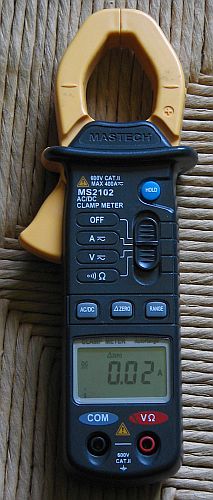
Eventually I came across this Mastech clamp meter. It was the cheapest
I found that measures DC too, and as a bonus it has a pretty good
resolution for a clamp meter, 0.01A. It will measure a maximum of 400A,
which is low for a clamp meter, but more than plenty for my needs. The
display covers -3999 to +3999. It has a basic accuracy of 2.5% in DC
and 2% in AC, good enough for most purposes.
This meter shouldn't be really called a multimeter. Although it has a
voltage function and a combined resistance/continuity function, their
performance is so poor that I almost never use them. For example, it
measures resistance only up to 400Ω! Everything above that value
appears as out of range. In voltage, it has only two ranges, 400 and
600V, with the best resolution being 0.1V. So, let's consider this
thing a current meter with some added "light" voltage and
resistance/continuity functionality, but the only part of it that's
really useful is the current function. That's what I bought it for, and
that's what I use it for. And I'm glad that I have this meter!
This meter does have some quirks and limitations even for current
measurement. One is that in DC it has roughly 0.03A of noise, so that
the reading in its lower range (40A) is always somewhat unstable. So,
while the rated resolution is 0.01A, in practice it's hard to measure
any current to better than 0.03A. Now this has to be understood in the
context of clamp meters being high current devices. When measuring tens
to hundreds of amperes, it works just great!
In AC there is less noise, so it works more accurately there.
The autoranging between the 40 and 400A current ranges works well, but manual range selection is available too.
The build quality is mediocre. The clamp doesn't always seat in the
exact same positions, and requires careful use to produce reliable
readings. The power and function switch developed contact trouble very
soon, and requires careful cleaning with a de-oxidizing contact cleaner.
My biggest complaint is about the battery usage. This meter runs
on two AAA cells, and consumes a whopping 29mA! This means that it
sucks the batteries dry in barely 20 hours of use. My usage of the
meter is rather intensive, and so I decided to run it on rechargeable
cells. Bad luck! The meter won't run correctly on the 2.5V or so
provided by two NiMh cells! It needs at least 2.6V to start giving
reasonable measurements, and 2.8V to reach full accuracy. But the low
battery indicator doesn't come on until the voltage is around 2.3V! It
took me quite a while to find this out, and I thought there were
contact problems when the meter gave nonsensical readings despite its
battery voltage being OK, according to itself!
So, this meter needs using FRESH alkaline AAA cells, and replacing
them as soon as the measurements start becoming quirky, such as the
zero reference running away or the meter reading low. The battery
condition indicator is useless.
Oh well. It was the cheapest DC-capable clamp meter I could find.
Still, it was more expensive than a pretty good non-clamp multimeter
having lots of functions. I did expect better quality. Still I'm happy
that I got any DC clamp meter at all, and I use it a lot.
Cen-Tech
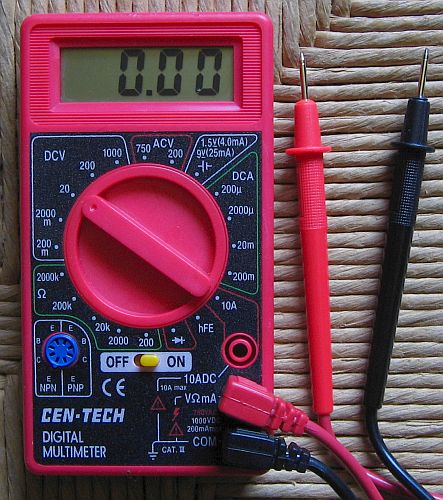 This
is an ultra cheap Chinese manual range multimeter. They come in many
slightly different flavors, colors, shapes, and totally different brand
names and model designations (if any). I got this one as a gift, from a
friend who had gotten several for free, along with orders for parts. He
gave me this one saying that one can never have too many multimeters.
This
is an ultra cheap Chinese manual range multimeter. They come in many
slightly different flavors, colors, shapes, and totally different brand
names and model designations (if any). I got this one as a gift, from a
friend who had gotten several for free, along with orders for parts. He
gave me this one saying that one can never have too many multimeters.
This little cheap thing is actually quite capable and useful. It has
one great feature: A power switch that's independent from the
function/range selector! It allows switching the meter on and off on
the spot, quickly, without disturbing the range setting.
It has the usual DC and AC voltage and current functions, but
lacking a highly sensitive AC ranges. It measures resistors to
2MΩ, which is modest too, but usable. It has no continuity
beeper. The measuring voltage in most resistance ranges is around 0.6V,
so it can partially turn on semiconductor junctions - not very
convenient. In diode testing mode, and interestingly also in the lowest
resistance range, it uses a 3V measuring voltage. So it can just test
white LEDs.
The display covers the basic -1999 to +1999 range, and the accuracy of
this instrument is anyone's guess - but in almost all practical work
it's plenty accurate enough! Even cheap meters like this one are
usually within 2%.
This meter has two special functions: Transistor gain, and battery test
under load. In this reagard it's much like my old Yu Fong.
The meter is powered by a 9V battery, and the current consumption is a
reasonable 0.8mA in voltage and current modes. In resistance
and diode modes instead it consumes 3.5mA! I suspect it has a
simple plain old three-terminal regulator to generate the
measuring current, and that this thing is responsible for the fourfold
increase in current drain in those modes!
Anyway this little instrument makes a very convenient everyday
multimeter, auxiliary meter, travel meter (since it's very small and
lightweight), and its low price makes it also a painlessly disposable
meter, should anything go wrong. It's simple and looks cheap, sure, but
does its job well, as long as one doesn't need extremes in range,
precision, and functions. I love its instant start-up, unlike highly
sophisticated meters that may take several seconds to initialize.
Uni-T UT71E
The time came when I wanted several performance features that
aren't available in cheap meters, and after all, all of my previous
meters were cheap ones! One such feature is true RMS measurement for AC
voltage and current. Another is increased precision, which is rarely
needed, but there are situations when it is at least desirable. Also
most meters lose a lot of accuracy in the AC ranges when the
frequency of the signal measured is far away from power line
frequencies; so I wanted a meter with an extended frequency range.
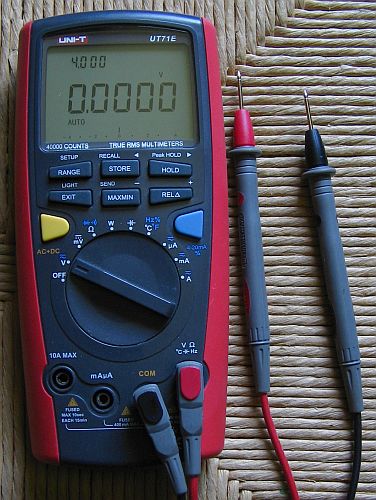
After shopping for some time, comparing features and prices, I decided
to buy this UT71E meter. Since it wasn't available in my country, I
imported it from China, where it is made. This was just a few years
ago, 2011 or so.
The specs of this meter are quite impressive. The display goes from
-39999 to +39999, and there are two four-digit subdisplays. The
basic accuracy is rated as 0.05% for most DC voltage ranges, which
degrades in other functions, but remains pretty good. In addition to
measuring the true RMS value of AC voltages and currents, this meter
can also measure the true RMS value of an AC+DC combination, or it can
strip the DC component, at the user's discretion. I have found this
quite useful.
There are several extra functions included. The instrument is pretty
capable measuring capacitance, covering from picofarads to 40mF (yes,
that's 40,000µF). It can measure frequency to 400MHz, with 0.01%
precision, which has rendered my old dedicated frequency counter mostly
redundant, except for really high precision measurement. It can
also measure temperature over a pretty wide range, using a thermocouple
that comes included. In the current range it has a special setting for
measuring industry-standard 4-20mA loops, reading in percentage. But
the nicests, greatest, sexiest function of all is that this meter will
measure real power, reactive power, and power factor! For this purpose
it comes with an adapter that plugs into the meter (using three
terminals) and has an AC male plug and female receptable. You plug it
into an outlet, plug any device into it, and comfortably read out the
real power, total power (real plus reactive), and the power factor, on
the meter's three displays! And all this with accuracy. That's a
dream come true.
The subdisplays are used in various ways. In most functions, the
left subdisplay is used to show the currently selected range. In AC
voltage and current functions, the right subdisplay measures frequency.
When Max/Min mode is selected, the two subdisplays show the ongoing
maximum and minimum values, while the main display shows the momentary
value - but this assignment can be changed at will.
A very often heard complaint is that digital multimeters, specially the
autoranging ones, are too slow. They will take several seconds before
they give a stable reading, and they can't follow variable signals very
well. To fight this problem, this meter has two useful functions. One
is a fast measurement mode: The main display is switched to 4000 count
mode instead of 40000 counts, with much faster update. The meter is
very responsive in this mode. And the other tool is a bar graph, that's
updated about 10 times as fast as the numerical display. This bar graph
can be configured to have the zero at center, or at left.
Speaking about configuration, this meter has a configuration menu, that
allows setting several parameters, such as auto power off timing (or
disabling this function), high/low alarms, or backlight timing.
This meter has data storage functionality. It can be set up to record
measured values in memory, at a selectable rate. These stored data can
be reviewed later, or it can be transferred to a computer, via the
included optocoupled USB interface and software. The same interface and
software can also be used to constantly transfer the values measured,
in realtime.
And there is more: A peak hold function, duty cycle measurement... But let's return to basic and important specs.
It's always important to know the measurement voltages. When measuring
resistance, this meter applies something that seems to be as high as 1V
in open circuit, but this gets lower fast with even a tiny load. Over a
10MΩ resistance it applies roughly 0.25V. So it can be used to measure
resistors in-circuit, but might make semiconductors conduct in some
cases. When measuring continuity, it applies -1.2V, so it will
definitely make semiconductors conduct! The polarity reversal might
confound the user, too. The response to continuity is not
instantaneous! There is a delay between closing the cirucit, and
getting a beep. That's very annoying, because it hampers searching for
a connection by sliding the test probe over the pins of a connector, or
such. And in diode test mode, it applies 2.8V, which is marginal
for testing white and blue LEDs, but fine for everything else. All
these things should have been better, in an advanced multimeter like
this one .
And now let me tell you my biggest grief: This darn multimeter uses a
9V battery, and consumes no less than 9.4mA in the basic functions, and
11.3mA in some other ones. So a 9V alkaline battery will last maybe 30
hours! That's awfully poor. I was quite shocked when my first battery
ran out of juice after just a few days of using this meter! Several
batteries later I figured out that this multimeter was a brutal power
hog, and decided to use it with rechargeable batteries. I bought two
"9V" NiMH batteries, which are actually 7-cell 8.4V, 200mAh ones. They
last 20 hours, and at least this meter runs perfectly on those NiMH
batteries. Every few days of moderate use I have to open the battery
compartment and switch the two batteries between the meter and the
charger. Almost like a smartphone... only that with a smartphone
you don't even get the chance to switch batteries!
I soon put away the screw of the battery compartment. It would wear out
too quickly. I just push the battery box in, as it fits tightly enough
not to fall out.
This meter is relatively free from additional quirks. I just would like
to mention one that sometimes disturbs me slightly: This is an
"intelligent" meter, and sometimes it seems to think it's more clever
than it really is. When trying to measure a very low value, suddenly
the display will change to 0.0000. Apparently there is a threshold
below which an auto-zero function activates, obliterating the signal to
be measured! It only happens with very tiny signals, though, so it's
not too bad. But was it really necessary to do this in the meter's
software?
Uni-T UT61A
 My
old Yu Fong is still my main multimeter, the one I use most,
despite its propensity to constant beeping and the need to plug the
positive probe into another hole about 642328324 times a day. The
Cen-Tech can't replace it because it's just too basic and flimsy. The
UT-71E can't replace it either, because of its outrageous current drain
that has me spending almost more time changing its battery than doing
electronics. So a few weeks ago I got weak and decided to buy yet
another multimeter. I wanted a relatively simple, straightforward,
inexpensive, but decent quality autoranging multimeter. The choice fell
on another Uni-T, because this is the only brand I can buy locally that
combines acceptable quality and price. And the model chosen was the
cheapest one of that brand that I could get here: The UT-61A. I
didn't decide the purchase just based on the price, but I did compare
specs with several other meters, before choosing this one.
My
old Yu Fong is still my main multimeter, the one I use most,
despite its propensity to constant beeping and the need to plug the
positive probe into another hole about 642328324 times a day. The
Cen-Tech can't replace it because it's just too basic and flimsy. The
UT-71E can't replace it either, because of its outrageous current drain
that has me spending almost more time changing its battery than doing
electronics. So a few weeks ago I got weak and decided to buy yet
another multimeter. I wanted a relatively simple, straightforward,
inexpensive, but decent quality autoranging multimeter. The choice fell
on another Uni-T, because this is the only brand I can buy locally that
combines acceptable quality and price. And the model chosen was the
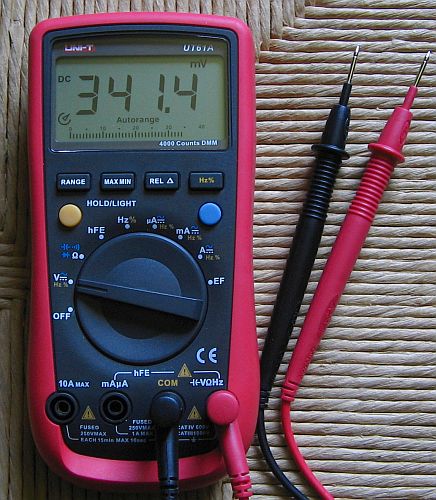
cheapest one of that brand that I could get here: The UT-61A. I
didn't decide the purchase just based on the price, but I did compare
specs with several other meters, before choosing this one.
This is a relatively straightforward multimeter, although it does
include several extra functions, like most modern meters do. Its
display goes from -3999 to +3999, and the rated basic accuracy is 0.5%
in most DC voltage scales, degrading to around 1% in AC and current
ranges. It measures resistance to 40MΩ. It uses around 0.44V to measure
resistance and continuity, which is fine, and about 2.9V for measuring
diodes, which is fine for most uses but a little short for white and
blue LEDs.
The extra functions of this meter include frequency to 10MHz,
capacitance, transistor gain, and a very nice "sniffer" function in
which it detects electrical fields, without any contact. This can be
used to find wires buried in a wall, to tell live from neutral wires,
and so on. It also has a max/min
Back to homo ludens electronicus.